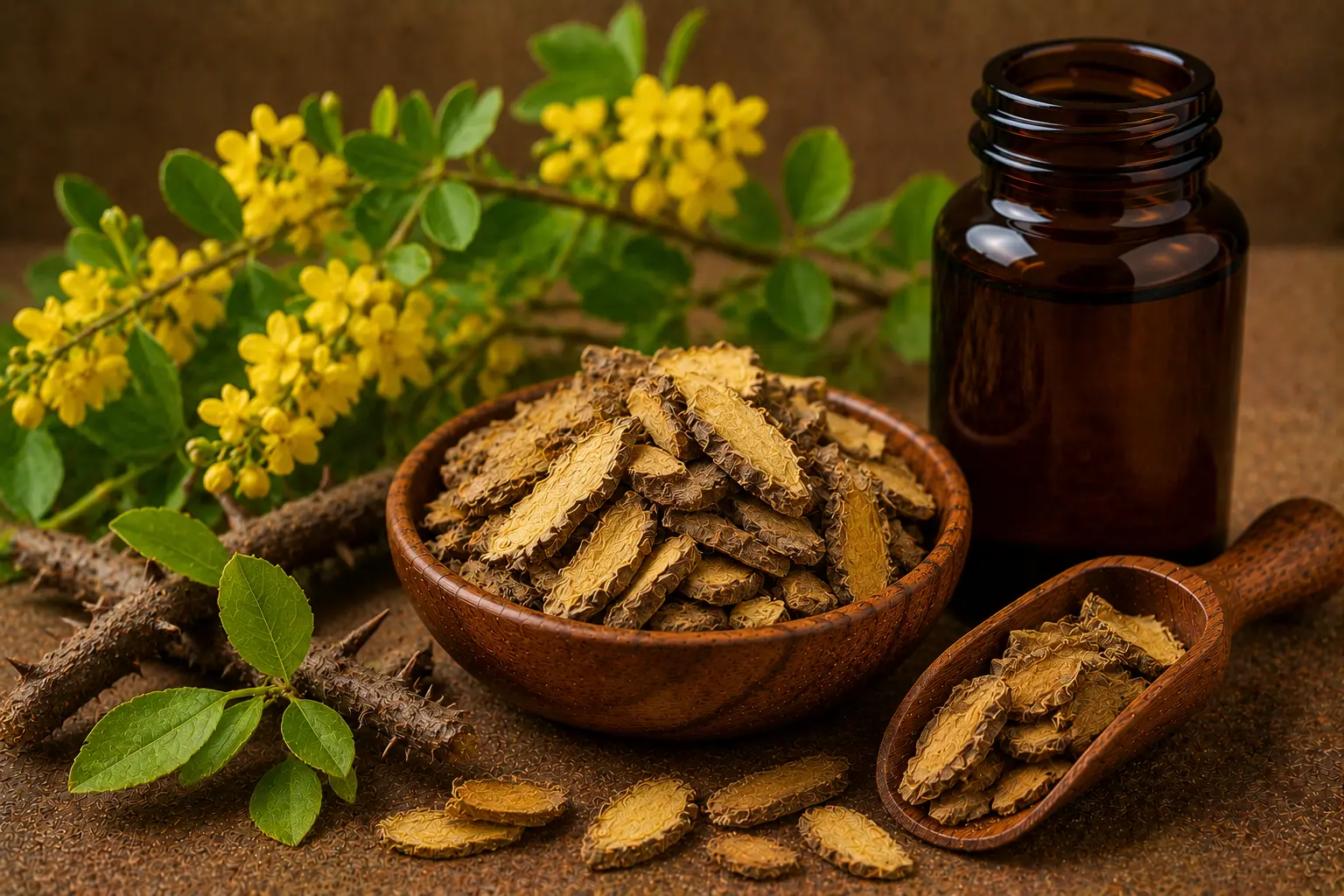
Raswanti
Berberis aristata · Indian Barberry · Daruharidra
A concentrated classical Ayurvedic extract of Berberis aristata, prepared by the traditional Raswanti method of slow evaporation. Rich in berberine and allied alkaloids, it is one of Ayurveda's foremost preparations for eye disorders, liver support, and metabolic health.
3–5%
Berberine
Solid
Physical Form
24 mo.
Shelf Life
What is Raswanti?
Raswanti is a classical Ayurvedic concentrated extract prepared from Berberis aristata — commonly known as Indian Barberry, Daruharidra, or Tree Turmeric. The preparation involves decocting the bark and roots of the plant in water, then slowly evaporating the liquid until a thick, dark solid extract is obtained. The name "Raswanti" literally means "the essence or juice that remains."
Described in the Ashtanga Hridayam and Sushruta Samhita, Raswanti holds a distinguished place in classical Ayurvedic ophthalmology (Shalakya Tantra) as the premier remedy for eye disorders including conjunctivitis, corneal opacity, and infections of the eyelid. Beyond the eyes, it is equally valued for its bitter hepatotonic, anti-diabetic, and gut-protective properties.
The SDR Raswanti is prepared by the authentic slow-evaporation method — no shortcuts, no synthetic concentration — yielding a dark brownish-black solid with the full alkaloid and phytochemical profile of the original plant.
Sourcing & Preparation
-
Bark and roots sourced from Berberis aristata growing in the Himalayan foothills of Uttarakhand and Himachal Pradesh
-
Prepared by classical aqueous decoction followed by controlled slow evaporation — preserving the full alkaloid matrix
-
No synthetic solvents, no spray-drying — only the traditional Ayurvedic concentration method
-
Each batch tested for berberine content, heavy metals, and microbial contamination by accredited third-party labs
Classical Context
In Ayurveda, Raswanti is classified under Shalakya Tantra (the branch dealing with diseases of the head, eyes, ears, and throat). It is considered the definitive Ayurvedic eye preparation, used for over two millennia to treat inflammatory, infectious, and degenerative eye conditions.
Shalakya
Ayurvedic Branch
2,500+ yrs
In Traditional Use
Key Active Compounds
Raswanti's therapeutic profile is defined by a rich spectrum of isoquinoline alkaloids, with berberine as the primary bioactive constituent.
Berberine
The principal alkaloid — one of the most extensively researched plant compounds in modern pharmacology. Demonstrates broad-spectrum antimicrobial, anti-inflammatory, anti-diabetic, and hepatoprotective activity. Active against gram-positive and gram-negative bacteria, fungi, and protozoa.
Berbamine
A bisbenzylisoquinoline alkaloid with potent anti-inflammatory, immunomodulatory, and cardioprotective properties. Research indicates activity against drug-resistant bacteria and certain tumour cell lines through calcium channel modulation.
Palmatine
A protoberberine alkaloid sharing berberine's structural backbone. Exhibits antispasmodic, sedative, and anti-inflammatory properties. Contributes to the digestive and hepatic effects of the extract alongside berberine.
Columbamine
A protoberberine-type quaternary alkaloid with documented antifungal, antibacterial, and anti-inflammatory activity. Contributes to Raswanti's effectiveness against ocular infections and inflammatory eye conditions.
Oxyberberine
The oxidised form of berberine, present in the bark. Demonstrates anti-ulcerogenic properties, supports intestinal barrier integrity, and has been studied for its role in gut microbiome modulation and bowel inflammation.
Tannins & Flavonoids
A secondary layer of polyphenolic antioxidants that reduce oxidative damage in ocular and hepatic tissues, enhance vascular integrity, and amplify the anti-inflammatory actions of the alkaloid fraction.
Health Benefits
Validated by both classical Ayurvedic literature and modern pharmacological research, Raswanti addresses a wide spectrum of conditions.
Eye Health & Ophthalmic Use
The primary classical indication. Raswanti is used as a collyrium (eye application) for conjunctivitis, blepharitis, corneal ulcers, pterygium, and inflammatory eye conditions. Berberine's broad-spectrum antimicrobial activity targets the most common ocular pathogens. Clinical studies confirm its efficacy against Staphylococcus aureus and Pseudomonas aeruginosa eye infections.
Liver & Digestive Health
A potent bitter tonic that stimulates bile secretion, improves hepatic function, and reduces liver inflammation. Berberine activates AMPK pathways to reduce hepatic fat accumulation, supporting non-alcoholic fatty liver disease (NAFLD) management. Traditionally indicated for jaundice, hepatitis, and sluggish digestion.
Blood Sugar Regulation
Berberine is one of the most clinically validated plant compounds for glycaemic control. Meta-analyses across 27+ RCTs show berberine reduces HbA1c, fasting glucose, and post-prandial glucose comparably to metformin, through AMPK activation and improved insulin sensitivity.
Antimicrobial Action
Raswanti demonstrates broad-spectrum activity against bacteria, fungi, and intestinal parasites. Berberine inhibits bacterial adhesion to host cells and disrupts biofilm formation — effective against drug-resistant organisms including MRSA. Used classically for diarrhoea, dysentery, and intestinal infections.
Cardiovascular Support
Berberine reduces LDL cholesterol and triglycerides by inhibiting PCSK9 expression, lowering cardiovascular risk independent of statin pathways. Also shown to reduce arterial stiffness, lower blood pressure, and improve endothelial function in multiple clinical trials.
Skin & Wound Healing
Applied topically, Raswanti is used in Ayurvedic formulations for skin infections, acne, eczema, and wound healing. Berberine inhibits keratinocyte proliferation and reduces inflammatory cytokines (IL-6, TNF-α), supporting management of psoriasis and inflammatory skin conditions.
Technical Specifications
General Parameters
| Botanical Name | Berberis aristata DC. |
| Common Names | Indian Barberry, Daruharidra, Tree Turmeric |
| Plant Part Used | Stem bark and roots |
| Preparation Method | Classical aqueous decoction + slow evaporation |
| Physical Form | Dark brownish-black solid / powder |
| Odour | Characteristic bitter, slightly pungent |
| Solubility | Soluble in water and dilute alcohol |
Quality Parameters
| Berberine Content | Min. 3% (standard) / Min. 5% (premium) |
| Total Alkaloids | Min. 6% |
| Loss on Drying | ≤ 8% |
| Heavy Metals (Total) | ≤ 10 ppm (WHO guidelines) |
| Microbial Load | Within API / IP limits |
| Shelf Life | 24 months from manufacture |
| Storage | Cool, dry place (<25°C), protected from light |
Packaging & Supply
Standard Pack
500 g, 1 kg, 5 kg, 25 kg
Packaging
HDPE containers / Food-grade pouches
Lead Time
3–7 working days
Formulation Applications
Raswanti is incorporated into a wide range of classical and modern Ayurvedic, pharmaceutical, and nutraceutical preparations.
Ophthalmic Preparations
Eye drops, collyriums, and Ayurvedic Anjana formulations for conjunctivitis, infections, and inflammatory eye conditions
Tablets & Capsules
Anti-diabetic, hepatoprotective, and digestive formulations — standalone or combined with complementary herbal extracts
Classical Formulations
Ingredient in classical preparations including Mahatriphala Ghrita, Triphaladi Churna, and various Arishta formulations
Topical & Dermal
Antibacterial creams, wound-healing ointments, and acne formulations leveraging berberine's antimicrobial and anti-inflammatory properties
Dosage in Finished Formulations
For oral formulations, typical dose in finished products is 125–500 mg of standardised extract per day depending on the indication. For ophthalmic use, berberine concentration in eye drops is typically 0.1–0.3%. All final formulations must be prepared and prescribed by a licensed Ayurvedic practitioner or pharmaceutical manufacturer.
These are primary crude drug substances — not for direct consumer use without further formulation.
Quality Assurance
GMP Certified
Good Manufacturing Practice
Ayurvedic Licence
Govt. of India certified
3rd Party Tested
Independent CoA per batch
ISO Certified
International quality standard
Ready to place a bulk order or request a sample?
Our team responds within 24 hours. CoA and product data sheet available on request.